
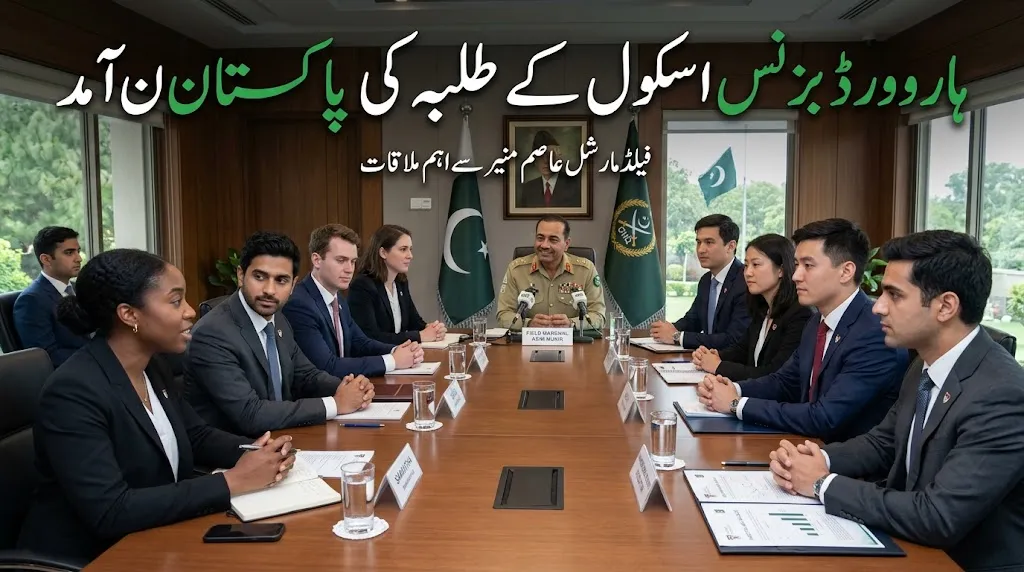
A delegation of students from Harvard Business School, representing different countries, recently visited Pakistan as part of an academic and international engagement program. One of the key moments of their visit was a high-level meeting with Chief of Army Staff and Chief of Defense Forces (CDF) Field Marshal Asim Munir in Rawalpindi.
The meeting provided an opportunity for the international students to discuss Pakistan’s security environment, regional developments, economic opportunities, education, entrepreneurship, and the challenges created by misinformation in the digital age.
The interaction also highlighted the importance of dialogue between international academic communities and national leadership at a time when businesses, governments, and institutions are dealing with rapid technological and geopolitical changes.
Read Also ; BISE Swat 9th Class Result Gazette 2026 PDF – Download & Check Result
Key Details of the Visit
| Topic | Details |
|---|---|
| Visiting delegation | Harvard Business School students |
| Representation | Students from multiple countries |
| Host | Field Marshal Asim Munir |
| Position | Chief of Army Staff and Chief of Defense Forces |
| Location | Rawalpindi, Pakistan |
| Main themes | Geopolitics, security, education, entrepreneurship and economic development |
| Additional focus | Critical thinking and responsible information use |
Discussions on Regional and Global Developments
According to the information shared about the visit, the discussions included developments affecting South Asia and the wider international environment.
Field Marshal Asim Munir briefed the delegation about Pakistan’s strategic outlook and its approach toward peaceful coexistence, regional connectivity, and economic development.
For students studying business and leadership, the discussion offered an opportunity to examine how geopolitical conditions can influence investment, trade, economic planning, and business decisions.
In today’s interconnected economy, companies often have to consider factors beyond traditional financial indicators. Political stability, security, infrastructure, regulations, technology, and regional relationships can all influence the long-term prospects of a market.
Read Also ; FBISE HSSC Result 2026 Date Expected for 12th Class FA, FSc, ICS
Pakistan’s Security and Economic Environment
Security was another important part of the interaction. The discussion included Pakistan’s counter-terrorism efforts and measures aimed at maintaining a secure environment.
A stable security environment can be important for economic activity because businesses need predictable conditions to invest, expand operations, create jobs, and develop long-term partnerships.
The meeting therefore connected two subjects that are often discussed separately: national security and economic development. For future business leaders, understanding this relationship can be particularly valuable when evaluating opportunities in emerging economies.
Focus on Education, Skills and Entrepreneurship
Youth development was also highlighted during the meeting.
Field Marshal Asim Munir emphasized the importance of quality education, professional skills, innovation, and entrepreneurship in building a stronger economy.
For young people, education is increasingly connected with practical skills. Technology, artificial intelligence, digital services, entrepreneurship, and international collaboration are changing the types of abilities required in the modern workplace.
Entrepreneurship can also contribute to economic growth by helping young people turn ideas into businesses, create employment, and develop solutions for local and international markets.
Read Also ; Qatar Jobs 2026: Urgent A to Z Facility Maintenance Vacancies – Apply Now
Why Youth Entrepreneurship Matters
| Area | Potential Impact |
|---|---|
| Education | Builds knowledge and professional capabilities |
| Skills development | Improves employability |
| Entrepreneurship | Supports new businesses and job creation |
| Technology | Encourages innovation and productivity |
| International collaboration | Opens opportunities for knowledge sharing |
| Critical thinking | Helps people make better decisions |
A Message About Misinformation and Critical Thinking
The rapidly changing information environment was another significant theme of the discussion.
Social media has made it possible for information to spread around the world within seconds. While this has created new opportunities for communication, it has also made misinformation and manipulated narratives more difficult to identify.
The visiting students were encouraged to place importance on facts, verification, critical thinking, and credible sources when assessing information.
This issue is particularly relevant to business leaders. Incorrect information can influence public opinion, financial decisions, corporate reputation, investment choices, and even international relations.
For professionals working in an increasingly digital economy, the ability to distinguish reliable information from unsupported claims is becoming an essential leadership skill.
Harvard Students Share Their Impressions of Pakistan
The visit was not limited to formal discussions. The Harvard Business School delegation also had an opportunity to experience Pakistan and interact with its people and culture.
According to the information provided about the visit, the students expressed positive impressions of their experience in Pakistan and appreciated the hospitality and warmth they encountered.
Such exchanges can provide international visitors with perspectives that may differ from what they encounter through international media or second-hand accounts.
Direct interaction can help students develop a more detailed understanding of a country’s society, business environment, culture, and economic potential.
Read Also ; Male Security Guard Jobs in Qatar 2026 – Salary, Eligibility & Apply Online
Why Academic Exchanges Matter
International academic visits can serve an important role in building connections between countries.
Students from leading institutions often go on to become entrepreneurs, executives, investors, researchers, policymakers, and other influential professionals. Their experiences during international programs can therefore shape how they understand different markets and societies.
For Pakistan, engagement with international academic institutions can also provide an opportunity to showcase its people, educational environment, businesses, technology sector, and economic potential.
These exchanges are particularly relevant as businesses increasingly operate across national borders.
Potential Areas for Future Collaboration
The interaction also points toward several areas where international academic and business engagement could develop further.
| Area | Possible Opportunity |
|---|---|
| Education | Student and faculty exchanges |
| Entrepreneurship | Startup and business collaborations |
| Technology | Innovation and knowledge-sharing programs |
| Business | Cross-border partnerships |
| Research | Joint research initiatives |
| Leadership | International leadership programs |
| Youth development | Skills and entrepreneurship initiatives |
Such cooperation does not necessarily depend on a single visit. Continued engagement between universities, businesses, entrepreneurs, and other institutions can create longer-term relationships.
A Broader Lesson for Future Leaders
One of the broader lessons from the interaction is the importance of understanding complex issues from multiple perspectives.
Modern leaders rarely deal with isolated problems. A business decision can be affected by technology, geopolitics, regulations, security, public opinion, and economic conditions at the same time.
For students preparing to enter leadership positions, international exposure can therefore be valuable. It encourages them to look beyond familiar environments and understand how different societies approach common challenges.
The meeting between the Harvard Business School delegation and Pakistan’s military leadership provided one such opportunity for direct dialogue.
Read Also ; WAPDA Jobs 2026 – Naib Qasid Jobs, Eligibility, Last Date & Apply Online
Conclusion
The visit of Harvard Business School students to Pakistan and their interaction with Field Marshal Asim Munir brought together international education, leadership, geopolitics, security, entrepreneurship, and economic development.
The discussions highlighted the importance of peaceful regional engagement, youth education, professional skills, entrepreneurship, and fact-based decision-making in an increasingly complicated world.
For the visiting students, the experience offered an opportunity to learn directly about Pakistan’s strategic and economic perspective. For Pakistan, such international exchanges can help strengthen academic and professional connections with future global leaders.
At a time when global challenges increasingly cross national borders, meaningful dialogue and direct engagement can play an important role in building greater understanding and identifying opportunities for future cooperation.
1 thought on “Harvard Business School Delegation Meets Field Marshal Asim Munir in Pakistan”